


Notes from The Pack
A giraffe striding across the landscape is a truly iconic sight, and it is no wonder that they fascinate us from childhood. These remarkable animals are not just uniquely African but also physiologically specialised for living in our environment. Our guest writer, Lin Cassidy, shares deeper knowledge on this wonderful animal that is found across our landscapes.
One of the creatures that most excites our imagination, and which is on the wish-list of every first-time visitor to Africa, is the giraffe.
To many, the giraffe embodies grace and elegance on the African plain. The giraffe stretches our sense of what a normal animal should look like, but at the same time, once seen, always seems just perfectly right.
Open acacia woodlands are the best place to look for giraffe. The open space allows them to spot predators, while the thorny acacia trees provide their preferred food. They are adapted to the heat, and hot, dry savanna conditions suit them well. Giraffes don’t need to drink daily, but they do need to be within a reasonable distance from some water source.
Giraffes form loose social groups, that break and re-form frequently, with group composition sometimes changing daily. As with many other savanna species, males often form small bachelor herds, that are more mobile and dynamic, while females form more stable bonds. Nursery groups can regularly be seen, where young giraffes are accompanied by a few older females, including ‘grandmothers’ – older non-reproductive females that work cooperatively to strengthen the survivability of the youngsters.
Perhaps one of the main things that most awes us about giraffes is just how big they are. Their extreme height and the grace with which they move may give them a sense of lightness, but they are big. The neck alone, at about 2 m (6.5 ft), is longer than most adult humans are tall. This length comes from having extra-long vertebrae, not from having more. In fact, it has the same number of vertebrae as a human’s neck. A giraffe’s head is about 62 cm long on average, and weighs about 30 kg – that’s about the same size and weight as an average chacma baboon. Males stand at about 5.5 m (18 ft) tall when fully grown and weigh almost 2 metric tons, while females reach a maximum height of 4.5 m (~15 ft) and weigh about 1.2 metric tons. Giraffes weigh between half and two-thirds of an elephant.
It requires some strength to move so much weight with such elegance! But giraffes have a long-distance speed of 16 km / hr (~10 mph) and can reach a maximum sprint speed of 60 km/h (37 mph) in short bursts. Its pace is enabled by its long legs, with each stride covering about 4 m when walking and 5 m when running. It would take only 20 strides for a giraffe to run the length of a football field. Even though they can cover a lot of distance with few paces, giraffes don’t move around too much, preferring to stay within a smaller home range when resources permit. As they browse, they will only cover about 3 or 4 km a day, travelling further when they need to find water.
Drinking is a challenge for giraffes. While antelope and zebra can simply dip their heads, the combined height of a giraffe’s legs and body is more than the length of its neck. Yet they can’t risk kneeling down, as their elongated body shape means that getting out of that position is a slow and clumsy manoeuvre. Kneeling makes them vulnerable to predation. Instead, they straddle their legs wide, lowering their entire body so that they too can dip their heads to reach the water. As they lower their head below their body, one would expect them to pass out as blood rushes down the neck. However, they have special valves in their jugular veins so that the blood pools in the neck instead of rushing to the head.
So much for the mechanics of getting into position – how do they then move the water up that 2 m long neck? After sucking water into their mouths, they open the epiglottis (a valve at the back of the throat), filling the oesophagus, before shutting the epiglottis again. They will repeat this for several ‘sips’ until the oesophagus is full, and then lift their head to allow gravity to complete the swallowing motion, bringing the water into the stomach. With drinking being a cumbersome and risky process, it is no wonder that giraffes have evolved to be able to go for days without water.
For the same vulnerability reason, giraffes very rarely lie down, and usually sleep standing up. When sleeping they may curve their neck backward to rest it along their flank. If they do lie down, they will do so for only a few minutes, sometimes resting their head on their rump. Calves are more likely to lie down because they have adults keeping watch.
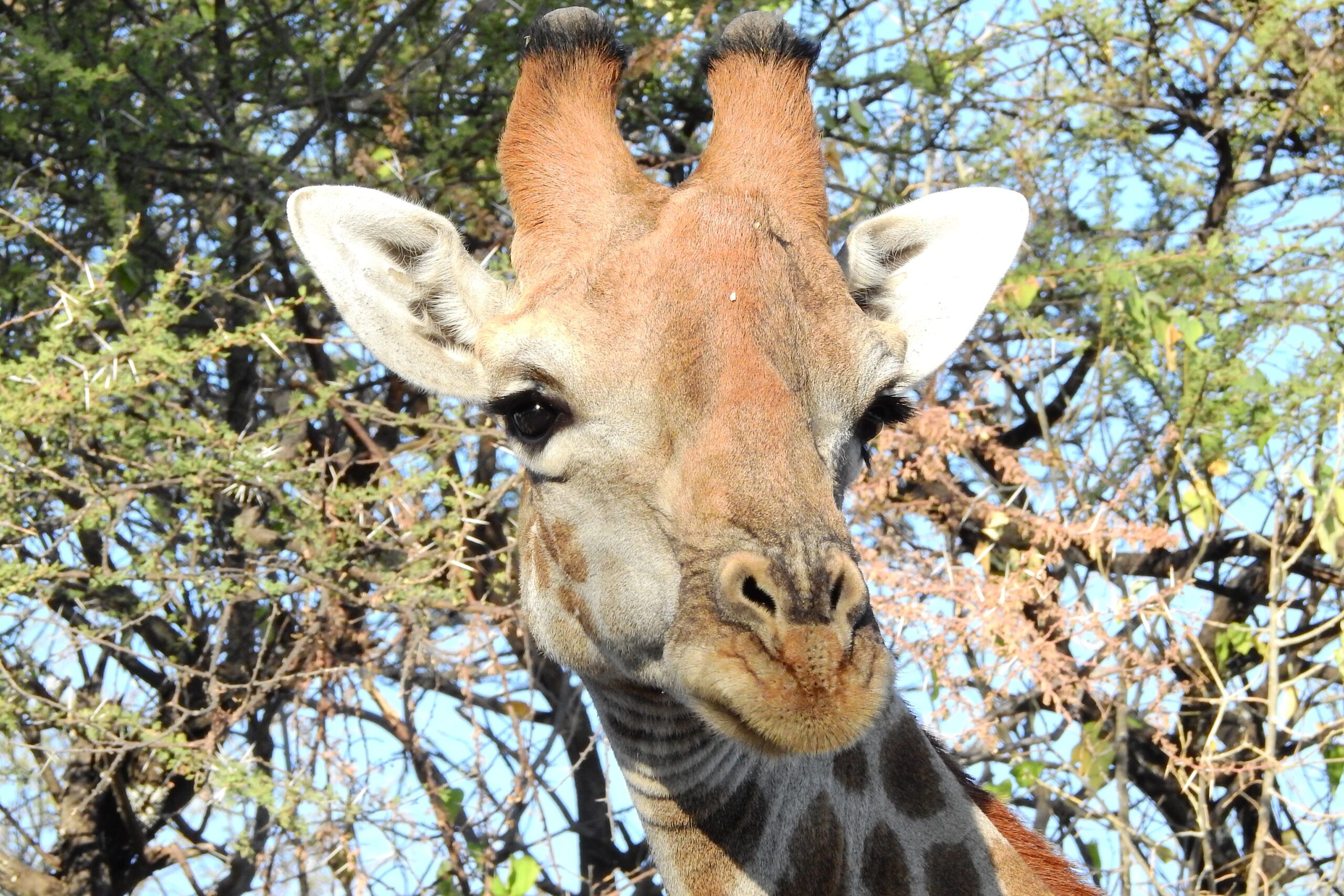
There are other curiosities about the giraffe. Those things on the top of the head that look like horns but aren’t horns, for one. The stumpy but cute protuberances are properly known as ossicones. Starting out as cartilage, they fuse to the skull at puberty, and are not solely decorative. Ossicones serve both male and female giraffes in regulating their temperature, but they also play a large role in male dominance, being used along-side ‘necking’, in sparring between males. Indeed, in adults, the condition of the ossicones can help identify whether a giraffe is male or female. Because females do not fight, they retain tufty hair on top of their ossicones, while in males this is rubbed off as the spar against each other.
Unlike among humans, necking between giraffes isn’t a sign of undying love or even gentle affection. Typically, giraffes use their powerful necks to try and prove to each other which one is strongest, and establishing physical dominance and consequent breeding rights. Amongst younger males, necking is low intensity and usually determines hierarchy, and sometimes seems more like playing. Among mature males the sweeping blows can become more violent, with those heavy heads used almost as hammers.
Another often overlooked curiosity is the giraffe’s tongue. Firstly, it is incredibly tough to allow it to crush the thorns present among the tiny leaves and flowers at the ends of the acacia bushes and trees that giraffes browse on. Secondly, it is an amazing blue-black colour. Scientists have shown that the dark colour is due to the concentration of melanin, a pigment that protects against intense UV rays. Giraffes need this protection because they use their tongues to browse, and spend as much as 12 hours a day feeding, with their tongue exposed to sunlight. Thirdly, the tongue is really long – reaching about 50 cm (almost 20 inches) – almost as long as their head! Not only is the tongue necessary for wrapping around branch tips to rip of leaves, but it also is used for licking the face, including the ears and eyes.
The giraffe’s eyes are also special. They are located to the sides of the head, so they don’t get in the way when browsing among thorns. The side position also gives them a wide field of vision for spotting predators and for easy assessment of distance. And while their thick eyelashes add to the giraffe’s beauty, their purpose is to keep dust and flies away.
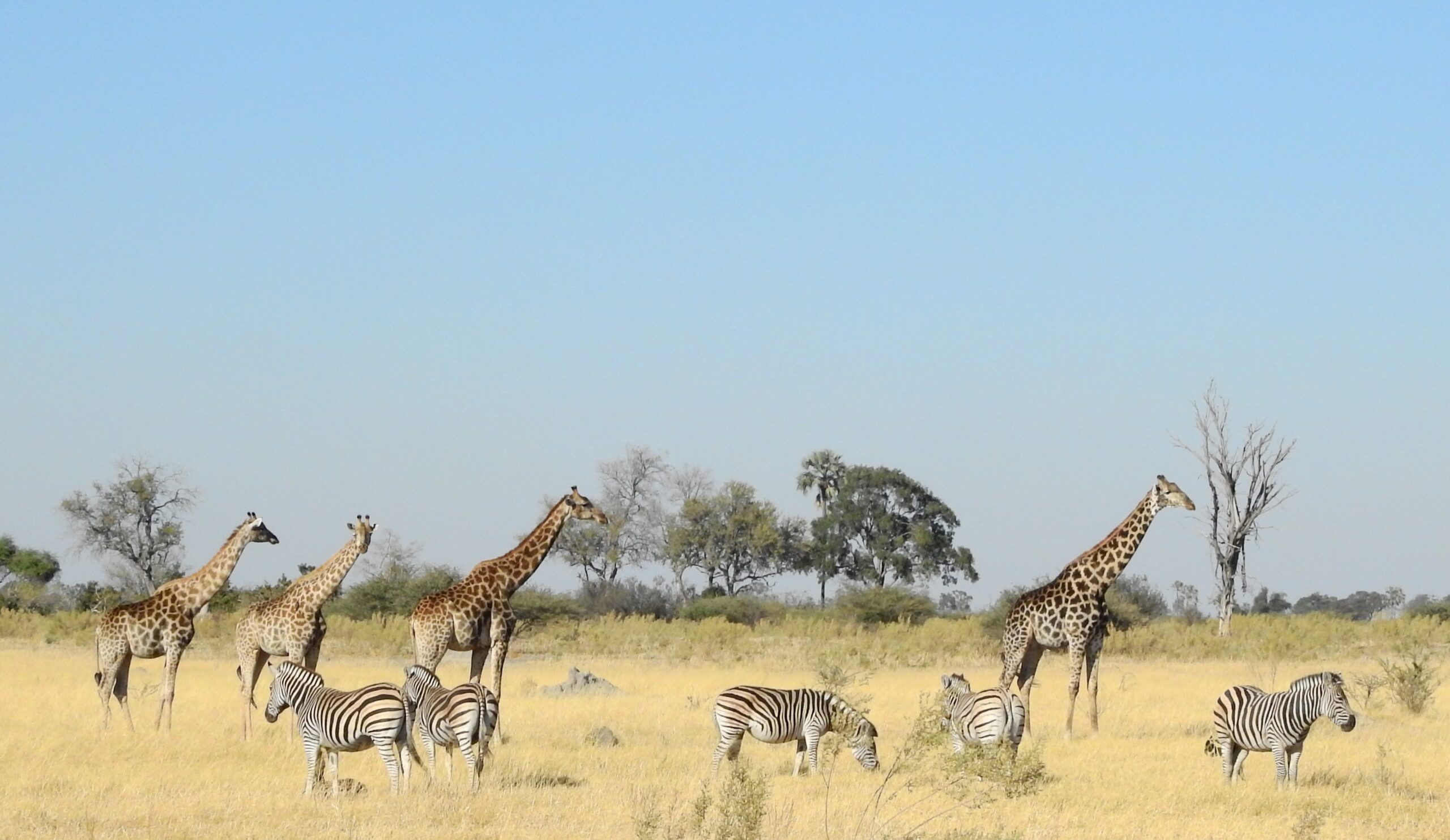
Photographing a giraffe can be challenging. If one zooms in so that the animal fills the frame, one often loses the sense of scale and the impact of its height and size is lost. It is better to photograph it from a distance, so that their size can be captured in comparison to other landscape elements such as trees. Zooming right in to the giraffe’s head, however, allows one to capture the details of those beautiful eyes and eyelashes, the bulging cheekbones and long jaw, all of which contribute to the characteristic sense of gentleness about the giraffe. Using portrait orientation will allow the length of the neck to stand out, and is good for behaviour or interactions. A low-angle, landscape-oriented shot that shows the giraffe rising about the treeline and capturing the big open skies also works well, while silhouettes at sunset capture the essence of a savanna evening.
Reach out to travel@thepack.africa or visit our camps to learn more.

Lin Cassidy is a Botswana citizen living in Maun. While much of her career has focused on conservation and development, she enjoys sharing her love for nature through words and art.