


Notes from The Pack
Chase Africa Safaris takes you to places that are hard to visit, off-the-beaten-path locations and the areas that need time to experience and explore. One of these special places is the Makgadikgadi pans, and our guest writer, Lin Cassidy, shares what makes them magical and worth exploring.
Experiencing Makgadikgadi Pans
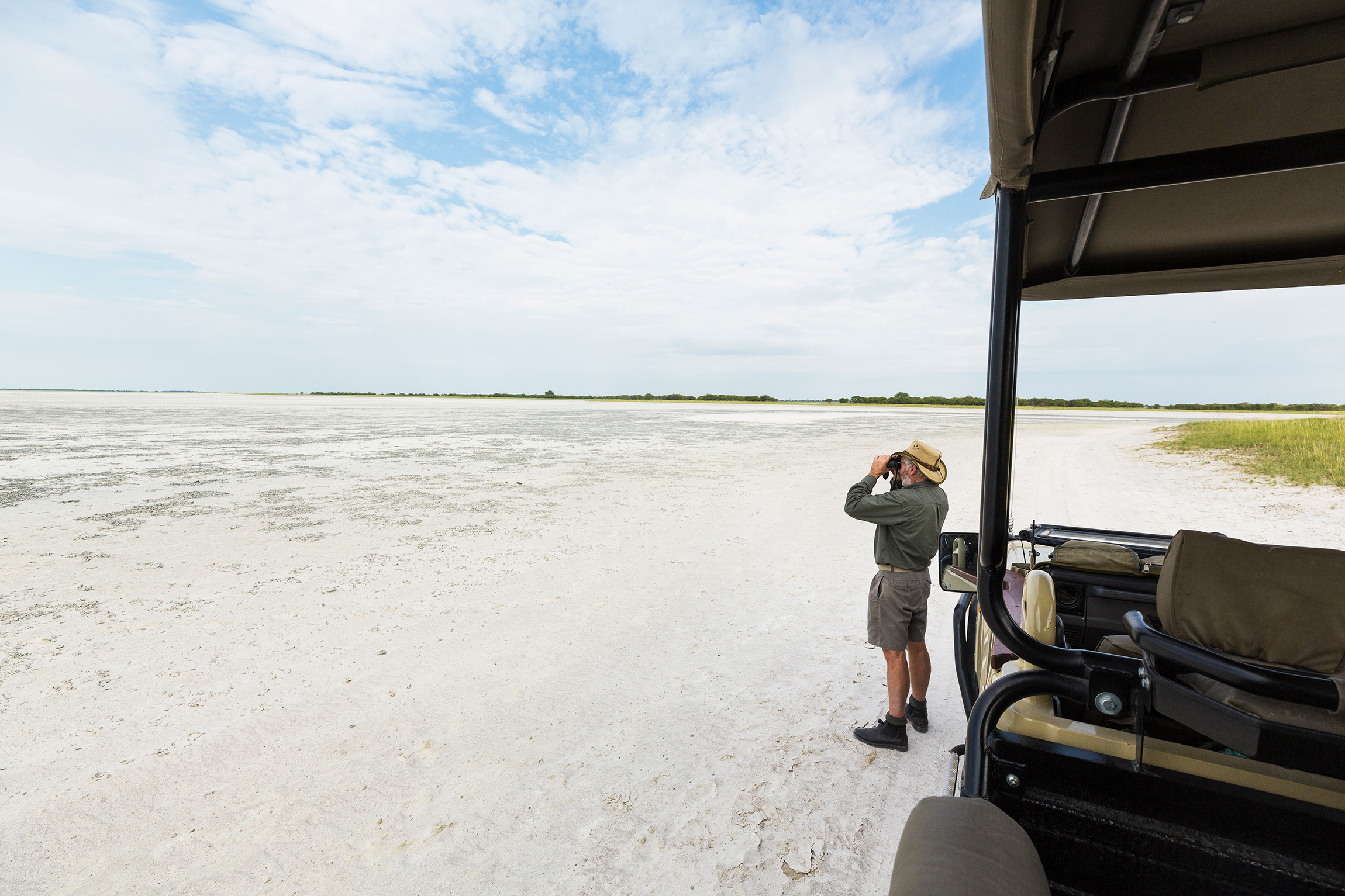
Your first glimpse of the pans reveals a vast, flat, dazzling-white expanse that stretches beyond the horizon. Distance and perspective are distorted, and far away, heat shimmers above the surface, creating mirages of distant tree islands. There is a sense of emptiness and of huge skies, and a feeling of release in the stillness.
Makgadikgadi Pans comprises two main salt pans – Sua (pronounced ‘sowa’) to the east, and Ntwetwe to the west – which are the remains of massive, but shallow, ancient lakes that were fed by the waters of the Okavango and other rivers from the north and east. which are two of the largest in the world. Some geologists speculate that at its greatest extent, the Makgadikgadi would have been a single immense lake that included even the area that is now the Okavango Delta. This lake began shrinking at least 20,000 years ago, a process accelerated by the extreme flatness of the Kalahari Basin plateau. The shapes and positioning of fossil sand dunes along the edges of the salt pans suggest that the strong easterly winds this region is known for have persisted since ancient times. Sua and Ntwetwe are surrounded by a myriad of smaller pans that became cut off as blowing sand created islands that blocked the spread of water. Because there is no outflow, the pans are known as an ‘endorheic’ basin.
If you are travelling in summer, you may witness miles of sheet water reflecting the dome of the sky. The pans may seem as if they are still massive lakes, albeit very shallow and very seasonal. The rainy season which supplies water to the pans is short and pronounced, and by May the water starts evaporating steadily. Most people visit the pans in the long and arid dry season, when the pans are once again dry, revealing the white salts drawn up from underground. The extreme northern part of Sua Pan receives localised annual inflow from the Nata River, and the Nata ‘delta’ portion of the pans rarely dries up completely. This wetter environment has created critical habitat for waterbirds, now protected by Nata Bird Sanctuary.
Even if you are traveling after the rains, it is important to remember that the clayey soils under the salt crust of much of the pans stays moist for much longer than might be visible at the surface. While it is tempting to drive off into the far nothingness where the sky and pan meet, getting stuck without shelter and potable water is a risk not worth taking. In most years, however, the margins of the large pans are completely dry throughout winter, as are the smaller ones that surround them. Then it is safe to walk out and hear the salt crunching underfoot in the stillness.
Despite the area’s dryness, there is archaeological evidence of San people living along the edges of the pans for tens of thousands of years. Being nomadic hunter-gatherers, they were able to adapt and respond to the changing conditions, following both the rain and the wildlife. There are records of San trading salt with people living in what is now Zimbabwe 500 years ago. Now, the San live in permanent settlements along the periphery of the pans, but still retain some of the traditions that supported their nomadic, hunter-gatherer lifestyle. A walk through the bush with the San will reveal unimagined sources of sustenance, while watching them perform fireside dances will connect you to a sense of ancient humanity.
Some say that the name Makgadikgadi means “the place of thirst”, accurately capturing the extreme dryness of the area which receives a very low mean annual rainfall of between 300 and 500 mm. Other say that the name means a vast and lifeless land. While both meanings are tangible in the dry winters when most people visit, in summer the pans and its surroundings are bursting with life.
So often we think of the pans as just the salt flat areas, but they also comprise the endless sea of surrounding grasslands. Here and there you will see small, scrubby thorn trees cling to life. On some of the larger promontories and islands, majestic, ancient baobabs loom out of the flatness. Baobabs are awe-inspiring not only for their enormous size and somewhat alien shapes. They are thousands of years old, and it is hard to imagine all the different ecological conditions that have survived through. They are often the only source of shade and shelter on the landscape, and are therefore a hub for life in an otherwise hostile environment. Endangered vultures nest in their branches, and bats, birds and insects feed on their flowers and fruit. To the north of the pans, you may notice by tall Hyphaene palm trees that stand like sentries at a gateway, allowing you pass to wide open spaces. Although typically associated with the Okavango Delta, these palms have grown from deposits by elephants many decades ago.
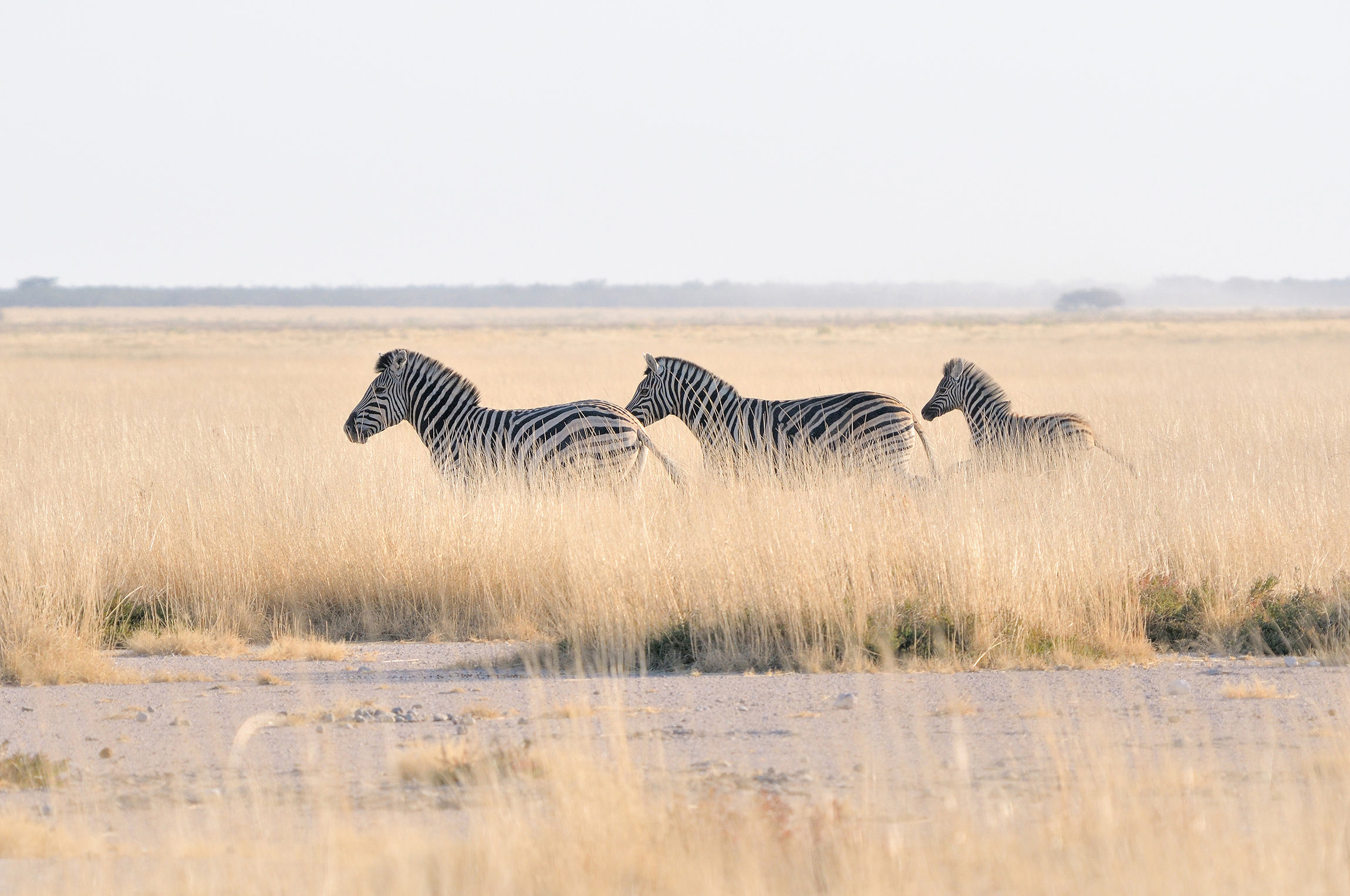
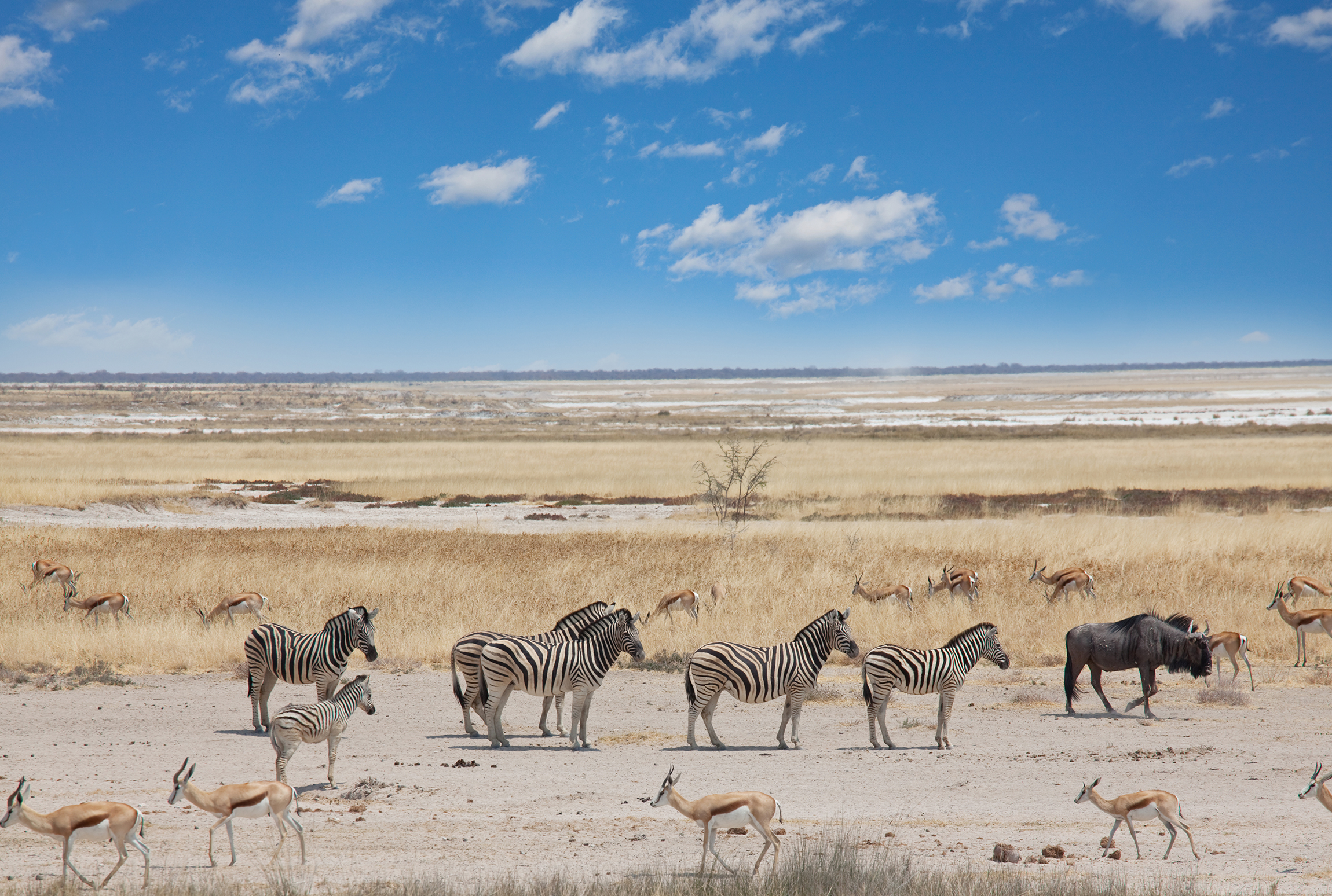
Yet it is the grasses themselves that are the foundation for animal life in Makgadikgadi. They are extremely nutrient-rich and provide important summer grazing for huge herds of migratory species such as wildebeest and zebra. If you are lucky and the timing is right, you may experience the sight of countless animals moving across the landscape. Sometimes these herds linger into the start of the dry season when surface water remains available, but often in winter, the plains belong to solitary gemsbok and springbok. Then, each animal seems, for its unexpectedness, like a prize revealed. The seasonal concentration of wildlife is a magnet for some of Botswana’s large predators, including lion and cheetah, with the latter in particular benefitting from the openness of the grasslands. But you may also be fortunate to see some of the smaller predators, which are equally exciting, perhaps even more so, because sighting them is rarer.
Among these are the black-backed jackal, the bat-eared fox, the brown hyena and the aardwolf, often appearing at night or at the edges of the day.
A most engaging experience in the pans is a visit to one of the meerkat clans. Over time, some of these families have become habituated to the presence of humans. To lie on the ground at their level as they go about their daily routines of grooming each other, digging for grubs and standing sentinel is simultaneously humbling and profoundly uplifting. Meerkats are highly social, and all adults take care of all the young. Yet one or two will also be on guard, standing tall on their back legs and scanning the skies for any raptors, which are their main predator.
For those interested in birding, there is also a surprisingly large number of bird species to be found in the pans. Those lucky enough to travel when the pans are still wet in places may have a chance to see both greater and lesser flamingos, pink from their diet of brine shrimp. Out in the grasslands, huge secretary-birds on long legs may be seen running down the tracks. Another prize sighting is the kori bustard, which is not only Botswana’s national bird, but also Africa’s largest and heaviest flying bird. There are other avian treats too. Some species take advantage of the open skies to perform remarkable aerial displays. Among these are the northern black korhaan which will fly more than 20 metres into the air before doing a tumbling drop to the ground. Another is the eastern clapper lark that does just that – claps its wings while ascending steeply, before plummeting down again.
Perhaps one of the most magical parts of a stay in the pans is the night. If you are there when the moon is big, there is the ethereal beauty of a half-seen and silhouetted landscape lit by moonlight reflecting off the salt pans. If you are there when there is no moon, you will see more stars than you have likely ever seen before, with the Milky Way showing the ‘path homeward’ – as it is known in San culture. Either way, the nights provide a chance to contemplate man’s place in the Universe. And as you fall asleep, the quiet emptiness will be broken by the eerie calls of hyena and jackal, the regular chirp of a barking gecko, and the soft ‘whoo’ of a little owl.
To learn more about visiting the Makgadikgadi reach out to travel@thepack.africa or visit the Chase Africa Safaris page.

Lin Cassidy is a Botswana citizen living in Maun. While much of her career has focused on conservation and development, she enjoys sharing her love for nature through words and art.